The old laptop is the best UPS I own
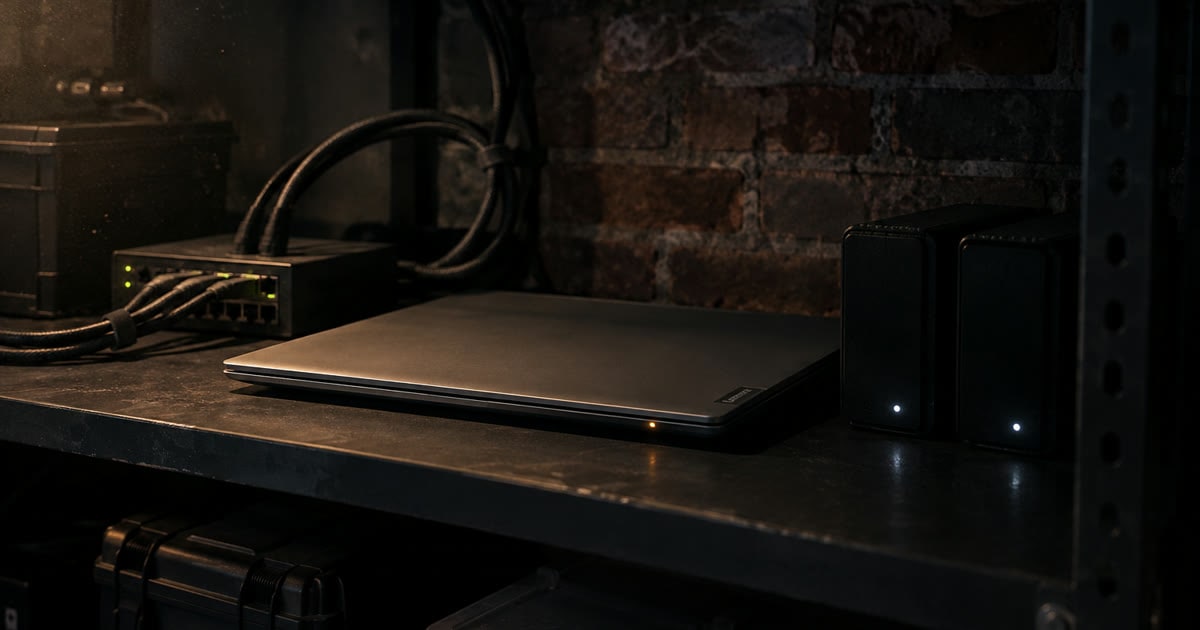
The NAS in this house is an old Lenovo Ideapad 320-15IKB with a Core i5-8250U, running NixOS with the screen closed. Before that it was a laptop. The reason it is still the NAS is not the CPU — it is the battery.
A UPS is a box you buy to imitate a laptop
A dedicated UPS for a small homelab is bulky, makes noise, burns standby power, and costs more than the hardware it protects. Meanwhile every laptop already contains a battery, a charge controller, and an embedded controller that is very good at knowing when the lights went out. What laptops do not ship with is a policy for what to do at 5%.
That is the whole project:
1
2
3
4
5
6
7
8
services.upower = {
  enable = true;
  usePercentageForPolicy = true;
  percentageLow = 15;       # warn
  percentageCritical = 8;   # urgent
  percentageAction = 5;     # act
  criticalPowerAction = "PowerOff";
};
Four numbers and a shutdown action. On a brownout the machine simply keeps running — services, storage pools, containers, all of it — with no UPS beep and no downtime, because a laptop does not consider losing mains power an event.
Why the graceful part matters more than the backup part
Uninterruptible power is nice. Clean shutdown of a Btrfs filesystem with live databases is the actual goal. The machine runs Immich, Vaultwarden and a handful of containers, and pulling the plug on those is how you get torn journals and half-written writes. A UPS that dies before the host notices is a UPS that fails exactly when it is needed.
With the upower policy, when the battery does reach 5% the host performs a normal systemd poweroff: filesystems unmount, database caches flush, containers stop in order. The battery’s last few percent are spent shutting down rather than holding the internet up for another four minutes.
The efficiency argument
Idle consumption on battery, while driving the storage pools and the services, measures about 1.96 W. A conventional UPS next to it would draw more than that just staying warm. Add silence — no fan, no transformer hum — and the fact that the hardware was already paid for, and the comparison stops being close.
The trade-offs are honest ones: a laptop tops out at two 2.5-inch bays, has a weak thermal budget and no ECC. It is not a server. But for a household NAS that has to survive the grid in a country where the lights flicker, the integrated battery plus a shutdown threshold is the cheapest reliable design I have found, and it degrades gracefully: when the battery eventually wears out, the machine still works, it just stops being a UPS.